



What Every Foreign Company Must Know About the Brazilian LGPD Before Doing Business in Brazil
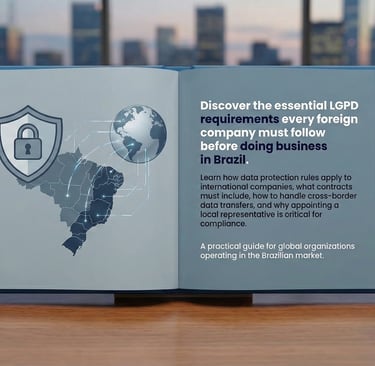
Discover the essential LGPD requirements every foreign company must follow before doing business in Brazil. Learn how data protection rules apply to international companies, what contracts must include, how to handle cross-border data transfers, and why appointing a local representative is critical for compliance. A practical guide for global organizations operating in the Brazilian market.
Laila dos Reis Araujo
12/10/20253 min read

As Brazil becomes one of the largest digital markets in the world, foreign companies increasingly engage with Brazilian clients, consumers, and partners.
However, many organizations underestimate one crucial point:
Doing business in Brazil — or simply processing data from individuals located in Brazil — automatically subjects your company to the LGPD, Brazil’s General Data Protection Law.
Failing to comply may lead to fines, blocked operations, contract losses, and significant reputational risk.
This guide highlights the essential LGPD requirements every foreign company must understand before entering the Brazilian market.
1. LGPD Applies Even If You Do Not Have an Office in Brazil LGPD has an extraterritorial scope.
Your company must comply if:
You offer goods or services to people in Brazil;
You process personal data collected in Brazil;
Your services impact individuals located in Brazil.
This means that SaaS platforms, e-commerce businesses, B2B service providers, marketing companies, and AI/tech developers are often automatically subject to the LGPD, even without physical presence in the country.
2. You Must Appoint a Local Representative
Foreign companies that fall under LGPD typically need a Brazilian legal representative (DPO or local agent) to:
Respond to data subjects;
Communicate with the Brazilian Data Protection Authority (ANPD);
Ensure compliance with local regulations;
Handle legal notices or investigations.
This is one of the most misunderstood obligations — but it is mandatory for most international operations.
3. Contracts With Brazilian Clients Must Include LGPD Clauses
Brazilian companies increasingly demand LGPD-compliant agreements from their suppliers, especially foreign ones.
Your contracts should include:
Lawful bases for processing
Data transfer mechanisms
Confidentiality and security obligations
Incident response procedures
DPA (Data Processing Agreement) aligned with LGPD
Allocation of liability and indemnification clauses
Without these elements, many Brazilian companies will simply refuse to sign.
4. Cross-Border Data Transfers Require Specific Safeguards
LGPD has strict rules for international transfers.
To legally send or receive data from Brazil, your company must rely on one of these mechanisms:
Standard Contractual Clauses (SCCs) approved by the ANPD
Adequacy decisions (still under development in Brazil)
Binding corporate rules
Explicit and highlighted consent from the data subject (not recommended as the primary mechanism)
Companies that ignore this requirement risk having transfers blocked by the regulator.
5. Security Measures Must Meet Brazilian Standards
LGPD requires companies to adopt technical and administrative measures to protect personal data.
This includes:
Encryption
Access control
Monitoring
Incident response plans
Vendor risk assessments
Governance frameworks
Security expectations in Brazil are increasingly aligned with global standards such as ISO 27001 and NIST.
6. Data Subjects Have Strong Rights Under LGPD
Individuals in Brazil can request:
Confirmation of data processing
Access and correction
Deletion
Portability
Information about shared data
Revocation of consent
Review of automated decisions
Foreign companies must be prepared to respond to these requests quickly and effectively — often through the local representative.
7. Non-Compliance Can Lead to Serious Consequences
LGPD penalties include:
Fines up to 2% of revenue in Brazil
Public disclosure of violations
Blocking or deletion of data
Suspension of processing activities
Contractual termination by Brazilian partners
For tech companies, blocking processing is often more damaging than fines.
8. Working With AI or Biometric Data Requires Extra Attention
AI-driven services, facial recognition, geolocation and other sensitive-data technologies are under strict supervision from the ANPD.
Foreign companies in these sectors must ensure:
Proper legal basis
Transparency
Risk assessments (DPIA)
Predictability of automated decisions
Protection against discrimination
This is especially relevant for SaaS, fintechs, HR platforms, ad-techs and security companies.
Entering the Brazilian Market Requires LGPD Readiness
Brazil is a high-opportunity market — but entering it without LGPD compliance is a legal and business risk.
Foreign companies that adapt early gain:
✓ smoother onboarding with Brazilian clients
✓ increased trust and credibility
✓ reduced regulatory exposure
✓ competitive advantage
And compliance is not as complex as it seems when guided by local experts.
Need LGPD support for your operations in Brazil?
Reis Araujo Advogados assists foreign companies with:
LGPD compliance programs
Local representative (DPO) services
Contract review and drafting
Cross-border data transfer solutions
Governance and AI regulatory advisory
Risk assessments and internal policies
👉 Speak with our team to ensure your expansion into Brazil is safe, compliant, and structured for long-term success.